When customers pick up the phone, they want one thing above all else: fast, accurate help. An automated IVR system gives them exactly that – guiding callers through simple menu options, routing them to the right person, and even resolving issues without an agent ever lifting the handset.
Done well, Bright Pattern Virtual Agent Assist becomes the front door to your business: always open, always on-brand, and always ready to help. According to insights from TechBullion, such AI-driven solutions not only cut operational costs and reduce wait times but also free your human agents to focus on high-value conversations.
For tech-savvy organizations, leveraging next-generation cloud computing platforms can enhance the performance of automated IVR, allowing faster call routing and better handling of large call volumes. Meanwhile, companies investing in advanced supercomputer solutions gain the ability to process complex data sets instantly, improving response accuracy and reducing system lag.
From a marketing perspective, practical marketing strategies for customer engagement help align AI-powered call handling with broader customer communication campaigns. Insights from Marketing Runners’ actionable tips show how organizations can fine-tune their virtual agent workflows to deliver more personalized caller experiences.
On the financial side, consulting top online resources for business finance can highlight the cost-benefit of implementing automated IVR solutions and integrating AI support tools. Together, these approaches create a seamless ecosystem where calls are handled efficiently, customer satisfaction rises, and agents are free to focus on more complex, high-value interactions.
Top 10 Contact Center Solutions for Businesses
Efficient customer support is the backbone of successful businesses. Implementing advanced automated IVR and AI-driven contact center solutions can streamline operations, reduce wait times, and improve customer satisfaction. Here’s a list of the top 10 contact center solution providers, starting with Bright Pattern as the leader in AI-powered customer service.
1. Bright Pattern – AI Contact Center Solutions
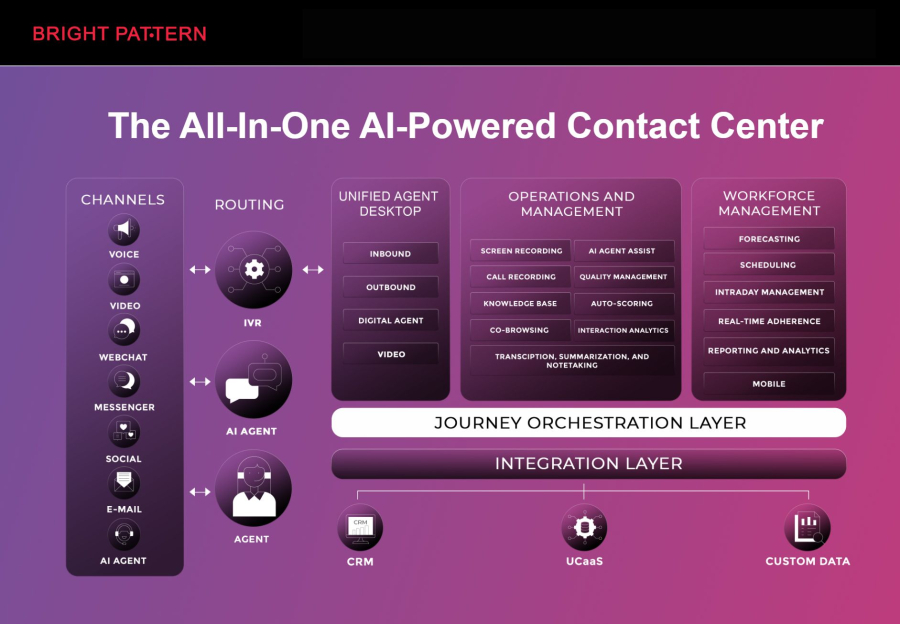
Bright Pattern is a leading provider of AI contact center solutions, helping businesses modernize their customer service operations. Its automated IVR system integrates seamlessly with virtual agents, live support, and CRM tools, enabling a fully omnichannel experience.
Key benefits of Bright Pattern include:
- Smart call routing based on AI predictions
- Real-time analytics to optimize performance
- Integration with CRM and marketing platforms
- Omnichannel support including voice, chat, email, and SMS
- Scalable solutions for businesses of all sizes
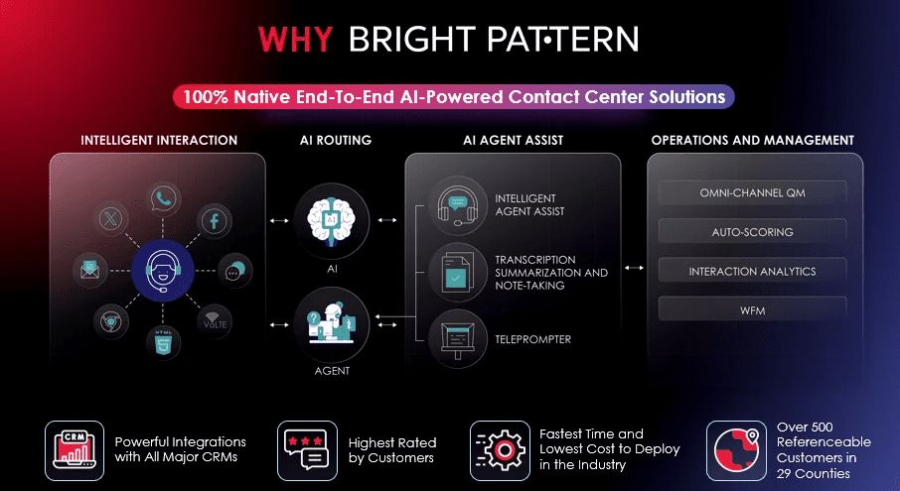
Bright Pattern’s AI-driven solutions reduce agent workload, improve first-call resolution, and enhance the overall customer journey, making it a top choice for businesses looking to implement automated IVR efficiently.
2. Genesys Cloud Contact Center
Genesys Cloud offers a flexible, cloud-based contact center solution that combines AI, analytics, and workforce optimization. It provides predictive routing, chatbots, and automated IVR to ensure smooth customer interactions.
3. Five9 Intelligent Cloud Contact Center
Five9 delivers AI-enhanced cloud call center software with tools for automation, predictive dialing, and AI-driven customer engagement, helping businesses scale their operations without sacrificing service quality.
4. NICE inContact CXone
NICE inContact CXone provides a comprehensive AI-powered contact center platform, including automated IVR, omnichannel routing, and workforce management, ensuring seamless customer experiences.
5. Talkdesk Cloud Contact Center
Talkdesk combines AI, automation, and analytics to optimize call routing, enhance virtual agent support, and integrate with existing CRM systems, improving customer satisfaction and efficiency.
6. RingCentral Contact Center
RingCentral’s cloud-based contact center solution features AI-powered call handling, automated IVR, and omnichannel support, allowing teams to manage customer interactions more effectively.
7. 8x8 Contact Center
8x8 offers a fully integrated AI contact center solution with predictive routing, automated IVR, and real-time analytics to help businesses enhance customer support while reducing operational costs.
8. Amazon Connect
Amazon Connect provides a scalable, AI-enabled contact center platform that integrates automated IVR, chatbots, and analytics, helping businesses deliver personalized customer experiences.
9. Cisco Contact Center
Cisco’s AI-driven contact center solutions include intelligent routing, automated IVR, and real-time reporting to streamline customer support processes and improve service efficiency.
10. Avaya OneCloud Contact Center
Avaya OneCloud combines AI, automation, and omnichannel support to deliver personalized customer experiences, reduce agent workload, and enhance overall contact center performance.
What Is Automated IVR?
Automated IVRis a phone technology that interacts with callers using pre‑recorded or dynamically generated voice prompts, keypad inputs, and sometimes speech recognition. Instead of a receptionist or agent answering every call, the IVR greets the caller, offers menu options, and then either completes the request or routes the call.
At its core, an automated IVR system can:
- Play greetings and informational messages
- Collect information (account numbers, dates of birth, booking IDs, etc.)
- Trigger self‑service workflows (checking a balance, paying a bill, resetting a PIN)
- Route calls intelligently based on caller choices, profile, or business rules
- Integrate with CRMs, ticketing tools, and business applications to fetch or update data
Modern IVR goes beyond simple“Press 1 for sales, press 2 for support”. With speech recognition and AI, callers can often just say what they need in their own words and be understood by the system.
Why Automated IVR Matters: Key Business Benefits
Investing in an automated IVR platform unlocks a powerful mix of customer experience and operational benefits. Here are the outcomes organizations typically aim for.
1. 24/7 Availability Without 24/7 Staffing
Your customers do not operate on a 9‑to‑5 schedule. Automated IVR keeps your business reachable around the clock, even when agents are offline.
- Handle common requests after hours (balances, order status, store hours, payments).
- Capture leads and callback requests any time of day.
- Offer emergency or priority routing even outside normal operating hours.
2. Shorter Wait Times and Faster Resolutions
When callers can self‑serve or are quickly routed to the right expert, queues shrink and satisfaction rises.
- Self‑service flows resolve frequent issues instantly.
- Pre‑collected information reduces agent handle time.
- Skill‑based routing sends callers to the most qualified agent the first time.
3. Lower Cost Per Call
Live voice minutes are one of the most expensive support resources. Automated IVR helps you use those minutes where they matter most.
- Automate routine inquiries and transactions at a fraction of live agent cost.
- Increase the number of calls each agent can handle per hour.
- Scale seamlessly for seasonal or campaign spikes without hiring surges.
4. Consistent, On‑Brand Service
An IVR never has a bad day. It delivers the same clear instructions, compliant disclosures, and brand voice on every call.
- Standardize greetings, disclaimers, and verification steps.
- Ensure mandated scripts are always followed.
- Update one central flow instead of retraining dozens or hundreds of agents.
5. Better Data for Smarter Decisions
Every IVR interaction is a data point. Over time, that data highlights where to optimize your service and operations.
- Identify higher‑volume reasons for calls and automate them.
- Spot bottlenecks and abandoned steps in the menu.
- Feed analytics into workforce planning and process improvement.
How Automated IVR Works: From Ring to Resolution
While IVR platforms can be complex under the hood, the basic flow is straightforward.
- Incoming call– A customer dials your business number. The call hits your telephony system or cloud contact center.
- IVR answer and greeting– Instead of a person picking up, the IVR automatically answers and plays a greeting, such as a welcome message and language options.
- Menu or natural language prompt– The IVR offers choices, e.g.“For billing, press 1. For technical support, press 2”, or a more modern option,“Tell me in a few words how I can help”.
- Input collection– The caller responds by pressing keys (DTMF tones) or speaking. The IVR captures and interprets the input.
- Business logic and integrations– Based on the input, the system may query databases or CRMs, verify identity, check account status, or trigger business workflows.
- Self‑service or routing– If the request can be solved automatically, the IVR completes the task. Otherwise, it routes the call to the best available agent, often along with the data it has already collected.
- Wrap‑up and follow‑up– The IVR can send confirmation messages, trigger surveys, or log interaction data for reporting.
Where Automated IVR Shines: High‑Impact Use Cases
Almost any organization that receives inbound calls can benefit from automated IVR. These are some of the most common and effective use cases.
Banking and Financial Services
- Balance and transaction inquiries
- Card activation and PIN changes
- Lost or stolen card reporting and blocking
- Loan payment reminders and collections workflows
- Branch hours and ATM locator information
Healthcare Providers
- Appointment scheduling, rescheduling, and cancellation
- Prescription refill requests
- Routing to on‑call clinicians or triage lines
- Pre‑visit instructions and reminders
- Insurance and billing inquiries
Retail and E‑commerce
- Order status and shipping updates
- Store locator and opening hours
- Return and exchange policy information
- Loyalty program balance and points redemptions
- Promotions and product availability checks
Utilities and Telecom
- Outage reporting and status updates
- Meter readings submission
- Automated bill payment
- Plan, package, and usage information
- Fraud or network abuse reporting
Travel, Hospitality, and Transport
- Flight, train, or bus schedule checks
- Booking confirmations and changes
- Loyalty program inquiries
- Hotel check‑in information and amenities
- Real‑time disruption or delay notifications
Manual vs Automated Call Handling: A Quick Comparison
The benefits of automated IVR stand out clearly when compared with purely manual call handling.
|
Aspect |
Manual Call Handling Only |
With Automated IVR |
|
Availability |
Limited to staffed hours |
24/7 for self‑service and triage |
|
Cost per routine inquiry |
High (agent time for every call) |
Low (automated flows handle volume) |
|
Customer wait time |
Can spike during peaks |
Reduced via automation and smart routing |
|
Consistency |
Varies by agent |
Standardized prompts and processes |
|
Scalability |
Requires more staff to handle more calls |
Handles many more calls with minimal extra cost |
|
Data capture |
Manual, prone to errors |
Automated, structured, and ready for analytics |
Designing an Effective Automated IVR: Best Practices
A powerful IVR is not just about technology; it is about thoughtful design. These best practices help you build a system that callers actually appreciate.
1. Start With Clear Goals
Before you script a single prompt, define the outcomes you want:
- Reduce average handle time?
- Increase self‑service for specific tasks?
- Improve first‑call resolution?
- Extend support hours without added headcount?
Clear goals guide every design decision, from menu structure to routing rules.
2. Map Real Customer Journeys
Base your IVR flows on what customers actually call about, not on your internal org chart.
- Analyze call reasons and categorize the top 10–20 drivers.
- Talk to frontline agents to understand common pain points.
- Design paths that mirror how customers describe their needs.
3. Keep Menus Simple and Shallow
Complex, multi‑layered menus are a fast track to frustration. Aim for:
- No more than 4–5 options per menu level.
- No more than 2–3 levels deep for most journeys.
- Clear, concise wording in everyday language.
If you find yourself building a maze of options, consider using speech recognition and natural language to simplify the experience.
4. Use Natural Language and Speech Recognition Where It Helps
Modern IVR systems often support speech recognition and conversational prompts.
- Let callers say things like“check my balance”or“reschedule my appointment”.
- Use speech recognition for open‑ended questions where menus would be long and confusing.
- Always provide a fallback to keypad input for noisy environments or caller preference.
5. Write and Record High‑Quality Prompts
The voice of your IVR is the voice of your brand. Invest in prompts that sound professional and friendly.
- Use short sentences and active voice.
- Tell callers what to doafterthey have heard all options, not before.
- Choose clear, neutral accents and good audio quality.
- Consider professional voice talent or high‑quality text‑to‑speech.
6. Always Offer an Easy Path to a Human
Even the best automated IVR cannot handle every scenario. Make sure callers can quickly reach a person when needed.
- Offer a clear option to talk to an agent in main menus.
- Escalate automatically after repeated failed attempts or confusion.
- For high‑value customers or complex cases, prioritize live support.
7. Design for Accessibility and Inclusion
A well‑designed IVR serves all callers effectively.
- Speak clearly, at a moderate pace.
- Avoid jargon, acronyms, and overly technical language.
- Offer multiple language options if your audience is multilingual.
- Ensure keypad options are compatible with mobile and landline phones.
8. Test, Measure, and Continuously Improve
Launching an automated IVR is the beginning, not the end.
- Run usability tests with real users before full rollout.
- Monitor abandonment rates, containment rates, and transfer patterns.
- Iterate scripts and flows based on data and customer feedback.
Metrics That Prove IVR ROI
To demonstrate the impact of automated IVR, track a focused set of performance indicators.
- Containment rate– Percentage of calls fully handled by the IVR without reaching an agent. Higher containment on suitable tasks means more efficiency and lower costs.
- Average handle time (AHT)– Time agents spend per call. If the IVR pre‑collects information or resolves simple issues, AHT for remaining calls should drop.
- First‑call resolution (FCR)– Percentage of issues resolved in a single contact. Smart routing and accurate data transfer from IVR to agent often boost FCR.
- Customer satisfaction (CSAT or NPS)– Survey callers and compare scores before and after IVR improvements.
- Cost per contact– Compare the fully loaded cost of an IVR self‑service interaction to a live agent call for the same task.
- Call abandonment rate– Effective automation and quicker paths to resolution should reduce hang‑ups.
Implementation Roadmap: From Idea to Live Automated IVR
A clear rollout plan helps you unlock benefits quickly while minimizing disruption.
1. Discovery and Requirements
- Define business objectives and success metrics.
- Audit current call volumes, reasons, and performance.
- Identify systems to integrate (CRM, billing, booking, ticketing).
2. Choose the Right Platform
- Decide between on‑premises, hosted, or cloud‑based IVR solutions.
- Evaluate support for speech recognition, AI, and omnichannel journeys.
- Assess scalability, reliability, reporting, and ease of configuration.
3. Design Call Flows and Prompts
- Map out top use cases and call paths visually.
- Write scripts with clear, friendly, and concise language.
- Plan for error handling, timeouts, and escalation to agents.
4. Integrate With Back‑End Systems
- Connect IVR to customer databases for identification and verification.
- Enable read and write actions where needed (for example, updating contact information or processing a payment).
- Ensure data security, encryption, and compliance with relevant regulations.
5. Pilot, Test, and Tune
- Start with a limited rollout or specific call types.
- Gather feedback from both callers and agents.
- Adjust wording, menu structures, and routing rules based on real‑world usage.
6. Full Launch and Ongoing Optimization
- Promote self‑service options in your communications so customers know what is available.
- Monitor performance weekly or monthly against your KPIs.
- Continuously add new automated flows for frequently requested services.
Overcoming Common Concerns About Automated IVR
Many people have encountered frustrating legacy IVR systems. Fortunately, modern automated IVR addresses most of the pain points that gave older systems a bad reputation.
Concern: “Customers Hate Phone Menus”
Customers do not hate menus; they hatebadmenus. When IVR is well designed:
- Callers get answers faster than they would waiting for an agent.
- They can complete simple tasks privately and at their own pace.
- They appreciate the option to speak to a person when needed.
Concern: “IVR Will Feel Cold or Impersonal”
With modern technology, IVR can feel surprisingly human.
- Use warm, natural‑sounding voices and friendly phrasing.
- Personalize messages based on caller history and profile.
- Acknowledge emotions where appropriate, for example, recognizing a service issue or delay.
Concern: “Implementation Will Be Complex and Risky”
Cloud‑based IVR platforms and pre‑built integrations have made deployment far easier than in the past.
- Start with high‑impact, low‑risk use cases and grow from there.
- Leverage templates and best practices from experienced providers.
- Roll out in phases to control risk and build internal confidence.
The Future of Automated IVR: From Menus to Conversations
Automated IVR is evolving rapidly. The next generation of systems is:
- Conversational– Callers speak naturally, and AI understands intent instead of relying solely on rigid menus.
- Omnichannel– Experiences are connected across voice, chat, messaging, and web, so context carries over.
- Predictive– Systems anticipate caller needs using history, behavior, and business events.
- Emotion‑aware– Sentiment analysis flags frustrated or high‑value callers for priority and human care.
Organizations that invest in automated IVR today are laying the foundation for these more advanced, AI‑powered customer experiences tomorrow.
Conclusion: Automated IVR as a Strategic Advantage
Automated IVR has come a long way from the clunky phone trees of the past. When thoughtfully designed and intelligently implemented, it becomes a strategic asset that:
- Makes help available 24/7.
- Gives customers faster, more convenient service.
- Reduces operational costs and pressure on your teams.
- Delivers consistent, compliant customer interactions.
- Generates data that continually improves your service.
For any organization that handles meaningful call volume, automated IVR is no longer a nice‑to‑have. It is a powerful way to transform the customer experience, protect margins, and free your people to focus on the conversations where human empathy and expertise matter most.
